Best AED for Remote Areas & Farms in Australia (2026 Guide)
26 March 2026
First Aid Requirements for Construction Sites in Australia (2026 Guide)
31 March 2026Best AED for Construction Sites & Trades in Australia (2026 Guide)
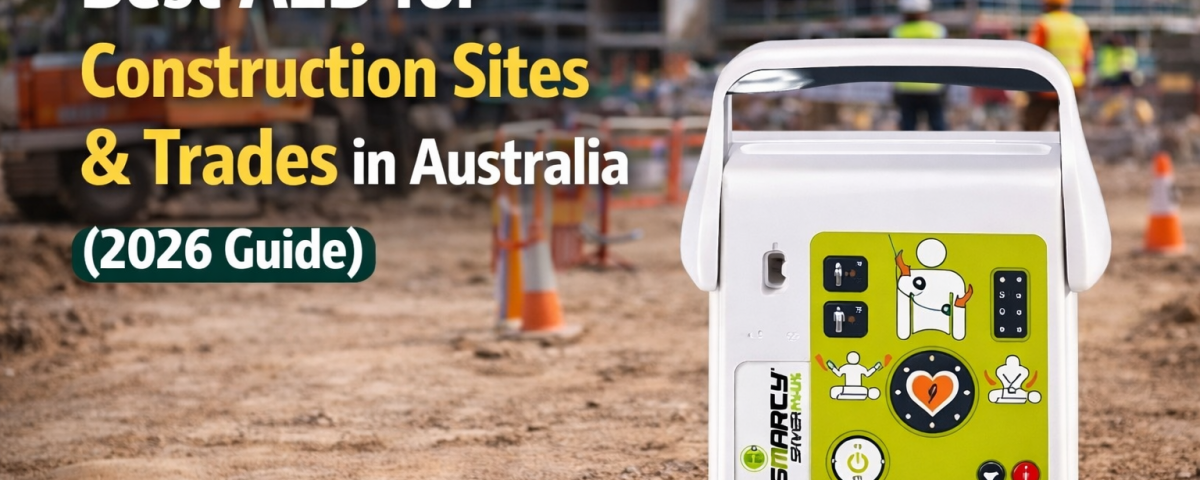
Defibrillator for Tradies and Construction Sites
Quick Answer
The best AED for construction sites and trades is one that is durable, easy to use, highly visible, and reliable in harsh environments. Simple AEDs with clear voice prompts and long-life components are ideal, especially where workers may not have medical training.
Do Construction Sites Need a Defibrillator in Australia?
AEDs are not mandatory on all construction sites, but:
👉 Under Work Health and Safety (WHS) laws, you must manage risks.
On construction sites, this includes:
- Physical strain
- Remote or large work areas
- Delayed emergency response
👉 In many cases, having an AED is considered best practice — and increasingly expected.
Why AEDs Are Important on Construction Sites
Construction environments often involve:
- Physically demanding work
- High temperatures
- Workers of varying age and health
- Large or spread-out worksites
👉 Sudden cardiac arrest can occur without warning — and access to immediate defibrillation is critical.
Real-World Scenario
Imagine:
- A worker collapses on-site
- Colleagues call for help
- Someone runs to retrieve the AED
👉 If the AED is:
- Hard to find
- Damaged or not maintained
- Complicated to use
👉 The outcome can change significantly.
Key Features to Look for in a Construction Site AED
✅ 1. Durability & Toughness
Construction sites are harsh environments.
👉 Your AED should be:
- Dust resistant
- Protected from impact
- Suitable for transport
✅ 2. Ease of Use
- Clear voice prompts
- Simple operation
- Minimal steps
👉 Most responders on-site will not be medically trained.
✅ 3. Visibility & Access
- Clearly marked location
- Central placement
- Accessible within minutes
👉 Large sites may require multiple AEDs.
✅ 4. Reliability
👉 The AED must work first time, every time
Look for:
- Proven manufacturer
- Strong warranty
- Reliable supply chain
✅ 5. Long-Life Pads & Battery
- Pads: 2–5 years
- Batteries: 2–5 years
👉 Reduces:
- Maintenance
- Risk of failure
✅ 6. Portability
Many sites:
- Move frequently
- Have multiple zones
👉 Consider:
- Carry cases
- Vehicle storage
Best AED for Construction Sites & Trades
🟢 Best All-Round Option
Smarty Saver SM2 / SM4 AED Range
A strong choice for most construction sites and trade environments.
Why it stands out:
- Simple, easy-to-use design
- Universal pads (adult & child)
- Low maintenance
- Portable and durable
- Cost-effective
👉 Best for:
Builders, tradies, small to medium construction sites
🔵 Premium Option
Best suited for:
- Large construction projects
- High-risk environments
- Tier 1 contractors
Key advantages:
- Real-time CPR feedback
- Advanced features
- Strong build quality
👉 Best for:
Large worksites, industrial environments
AED Comparison for Construction Use
| Feature | Smarty Saver SM2/SM4 | Zoll AED 3 |
|---|---|---|
| Ease of Use | Very simple | Advanced |
| Durability | High | Very high |
| Portability | High | Moderate |
| Maintenance | Low | Moderate |
| Price | Lower | Higher |
| Best For | Most sites | Large/high-risk sites |
Where Should an AED Be Located on Site?
Best locations include:
- Site office
- First aid station
- High-traffic areas
- Near main work zones
👉 Larger or multi-level sites may require multiple AEDs.
Mobile Trades (Tradies & Vehicles)
For electricians, plumbers, and mobile trades:
👉 Consider keeping an AED in:
- Utes
- Vans
- Work vehicles
👉 Important:
- Protect from heat
- Use a carry case
- Ensure easy access
Maintenance on Construction Sites
- Assign responsibility to a site manager
- Perform regular checks
- Track pad and battery expiry
👉 Harsh environments make maintenance even more important.
Cost vs Risk
AED cost:
- ~$1,400 to $3,000+
Compare this to:
- Worker safety
- Downtime and liability
- Emergency response delays
👉 For most construction businesses, the cost is minimal compared to the risk.
FAQs
Are AEDs required on construction sites in Australia?
Not always mandatory, but strongly recommended under WHS risk management.
Can untrained workers use an AED?
Yes — AEDs provide step-by-step voice instructions.
Should tradies carry AEDs in vehicles?
In some cases, yes — particularly for remote or solo work.
How many AEDs should a site have?
Depends on size and layout — aim for access within minutes.
Final Recommendation
If you’re choosing an AED for construction or trades:
👉 Prioritise durability
👉 Choose simplicity
👉 Ensure visibility and access
👉 Minimise maintenance
For most sites:
👉 A simple, reliable AED like the Smarty Saver SM4 provides the best balance of safety, usability, and cost.
Explore AEDs for Construction & Trades
👉 Shop Defibrillators at First Aid Kits Australia
👉 Learn Best Defibrillators in Australia
👉 Learn Defibrillator Cost in Australia (2026 Full Breakdown)
👉 Learn How to Maintain a Defibrillator (AED Compliance Guide Australia)


 by
by