Best AED for Sports Clubs & Gyms in Australia (2026 Guide)
26 March 2026
Best AED for Construction Sites & Trades in Australia (2026 Guide)
27 March 2026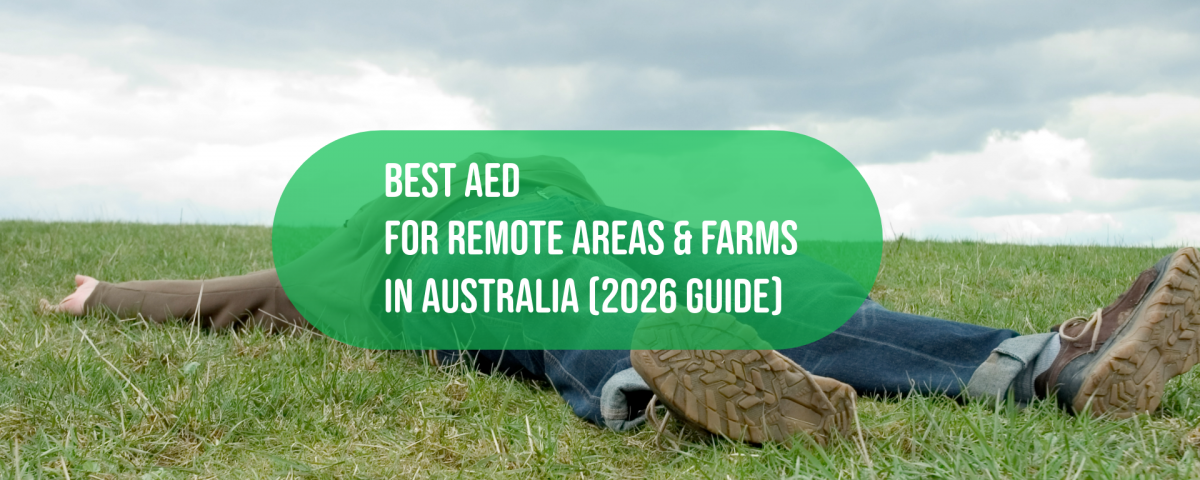
Quick Answer
The best AED for remote areas and farms is one that is highly reliable, durable, easy to use, and has long-life batteries and pads. In remote environments where emergency response times are longer, simplicity and reliability are far more important than advanced features.
Why AEDs Are Critical in Remote Areas & Farms
In remote locations:
- Ambulance response times are often longer
- Medical assistance may not be immediately available
- Workers may be isolated or working alone
👉 In these environments, an AED is not just helpful — it can be life-saving.
Real-World Risk (Remote Scenario)
Imagine:
- A worker collapses in a paddock or shed
- Help is minutes away — or longer
- Someone retrieves the AED
👉 If the device is:
- Hard to use
- Not maintained
- Not nearby
👉 The outcome can be very different
Key Features to Look for in a Remote AED
✅ 1. Reliability (Most Important)
In remote environments:
👉 The AED must work first time, every time
Look for:
- Proven manufacturer
- Strong warranty
- Stable supply and support
✅ 2. Simplicity & Ease of Use
- Clear voice prompts
- Minimal steps
- Suitable for untrained users
👉 In remote settings, responders are often not medical professionals.
✅ 3. Long-Life Pads & Battery
This is critical.
- Pads: typically 2–5 years
- Batteries: 2–5 years
👉 Fewer replacements = lower risk of failure
✅ 4. Durability & Portability
- Dust-resistant
- Suitable for vehicles (ute, truck)
- Portable between locations
✅ 5. Child Compatibility
Even in rural environments:
- Families often present
- Visitors or workers may have children
👉 Choose an AED that:
- Works for both adults and children
- Minimises steps (universal pads preferred)
Best AED for Remote Areas & Farms
🟢 Best Overall (Remote & Farm Use)
Smarty Saver Plus SM4 Defibrillator AED
The Smarty Saver SM4 is one of the best options for farms and remote locations.
Why it stands out:
- Simple operation with clear prompts
- Universal pad compatibility (adult & child)
- Low ongoing maintenance
- Competitive pricing (~$1,700 range)
- CPR feedback to assist rescuers
👉 Best for:
Farms, rural properties, small worksites, general remote use
🔵 Premium Option (High-Risk / Industrial Remote Use)
The Zoll AED 3 is designed for higher-risk environments.
Key advantages:
- Real-time CPR feedback
- Advanced diagnostics
- Strong build quality
- Long warranty
👉 Best for:
Mining sites, large rural operations, industrial environments
AED Comparison for Remote Use
| Feature | Smarty Saver SM4 AED | ZOLL AED 3 |
|---|---|---|
| Ease of Use | Very simple | Advanced |
| Reliability | High | Very high |
| Child Compatibility | Universal pads | Universal pads |
| Maintenance | Low | Moderate |
| Price | Lower | Higher |
| Best For | Farms / general remote | High-risk / industrial |
Where Should You Keep an AED on a Farm?
Best locations:
- Main house
- Workshop or shed
- Vehicle (ute/truck)
- Machinery areas
👉 Larger properties may require multiple AEDs
Vehicle & Mobility Considerations
For farms and remote work:
👉 Many users:
- Keep AEDs in vehicles
- Move between locations
👉 Consider:
- Carry cases
- Temperature exposure
- Secure storage
Maintenance in Remote Locations
- Perform regular checks
- Track pad and battery expiry
- Store in safe temperature conditions
👉 Choosing a low-maintenance AED is critical in remote environments.
Cost vs Risk (Important Perspective)
AED cost:
- ~$1,400 to $3,000+
Compare this to:
- Distance from emergency services
- Risk exposure
- Value of immediate response
👉 For remote environments, the value is significantly higher
FAQs
Do farms need a defibrillator in Australia?
Not mandatory, but strongly recommended due to isolation and delayed emergency response.
Can an AED be stored in a vehicle?
Yes, but temperature and protection must be considered.
What is the most important feature for remote AEDs?
Reliability and simplicity.
How many AEDs should a large property have?
Enough to ensure access within minutes — often more than one.
Final Recommendation
If you’re buying an AED for a farm or remote area:
👉 Prioritise reliability
👉 Choose simplicity over complexity
👉 Ensure long-life components
👉 Consider portability
For most rural users:
👉 A simple, reliable AED like the Smarty Saver SM4 provides the best balance of safety, cost, and usability.
Explore AEDs for Remote Areas
👉 Shop Defibrillators at First Aid Kits Australia
👉 Learn Best Defibrillators in Australia
👉 Learn Defibrillator Cost in Australia (2026 Full Breakdown)
👉 Learn Do You Need a Defibrillator at Work
👉 Learn How to Maintain a Defibrillator (AED Compliance Guide Australia)


 by
by